
Marketing Case Studies for Plastic Surgeons and Med Spas
Real results from surgical practices, med spas, and aesthetic businesses, and what they mean for yours
All case studies
- Surgical
Reconstructive surgeon: search traffic up 778% in five months
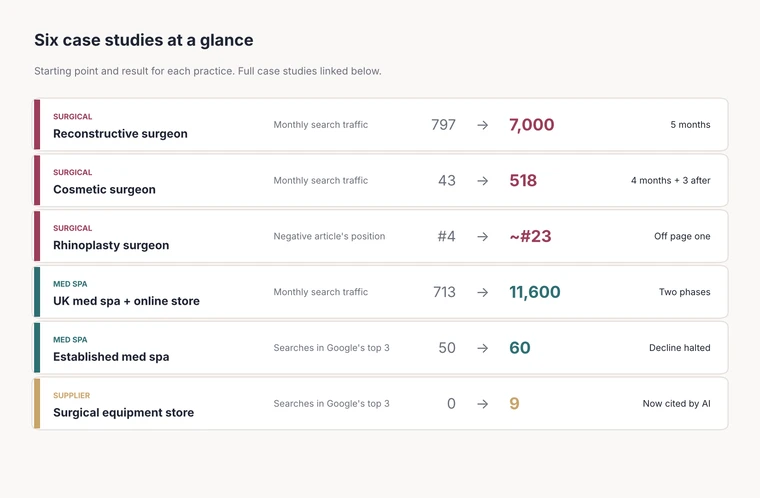
Monthly search traffic797→ to 7,000Read the case study - Surgical
Cosmetic surgeon: a neglected website grows 12x
Monthly search traffic43→ to 518Read the case study - Surgical
Rhinoplasty surgeon: a damaging headline pushed off page one
Negative article's position#4→ to ~#23Read the case study - Surgical
Breast augmentation surgeon: from page 6 to #1 in four months
Main search rankingPage 6→ to #1Read the case study - Med spa
UK med spa with an online store: search traffic up 15x
Monthly search traffic713→ to 11,600Read the case study - Med spa
Med spa with a cosmetics store: search traffic up nearly 4x in two years
Monthly search traffic37,500→ to 145,000Read the case study - Med spa
Established med spa: halting a year-long decline
Searches in Google's top 350→ to 60Read the case study - Supplier
Surgical equipment store: from invisible to cited by AI
Searches in Google's top 30→ to 9Read the case study
Why Aesthetic Practices Need Their Own Case Studies
Marketing a plastic surgery practice or med spa isn't like marketing a restaurant or a plumber.
Your patients research longer and harder than almost any other kind of customer. Someone considering a rhinoplasty, a breast augmentation, a facelift, or even their first round of injectables will look up your name, read your reviews, compare before-and-after galleries, and increasingly ask ChatGPT or Google's AI tools who the best provider is near them. Many of them do this for weeks before they ever request a consultation.
Google knows this. It puts health and cosmetic procedures in a special category where it demands more proof of credibility before ranking a practice. When Google updates its algorithm, aesthetic practices often feel it first and hardest.
That's why generic agency case studies about e-commerce stores or software companies don't tell you much. You need to see what works for practices like yours.
How Does Social Media Influence Plastic Surgery Patients?
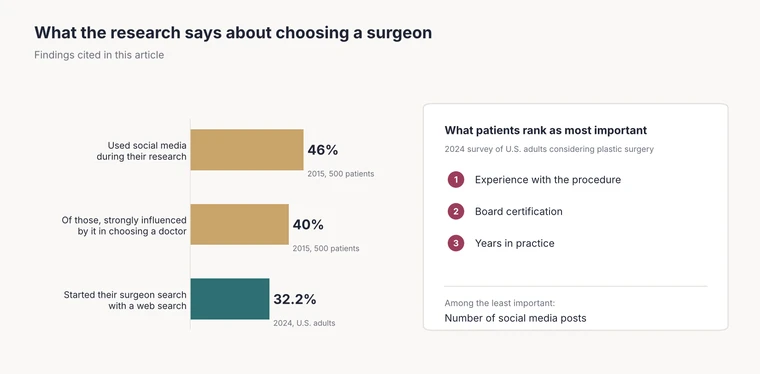
Social media is where many people first meet the idea of a procedure, so it helps to know what it does and what it doesn't do. In a 2015 study in Aesthetic Plastic Surgery of 500 consecutive patients at an aesthetic plastic surgery clinic, 46% of patients used social media, and 40% of those users were strongly influenced by it when choosing a specific doctor.
Other research adds a note of caution about what social media does to interest in surgery. In an experiment published in Current Psychology, 118 women aged 18 to 29 were shown either images of women with facial cosmetic enhancements or images of travel destinations. Viewing the cosmetic images increased their desire for cosmetic surgery, especially among women who spent a lot of time on social media. A 2024 systematic review in Cureus of 25 studies and 13,731 participants found that platforms such as Instagram and Snapchat can shape interest in cosmetic surgery, and its authors raised ethical concerns about misleading advertisements, unrealistic beauty standards, and patient privacy.
Influence on interest isn't the same as influence on which surgeon someone chooses. In a 2024 survey in Plastic and Reconstructive Surgery of U.S. adults who were considering plastic surgery now or in the future, a web-based search was the most common first step in finding a surgeon (32.2%). Respondents ranked a surgeon's experience with the procedure, board certification, and years in practice as the most important factors, and the number of social media posts as one of the least important.
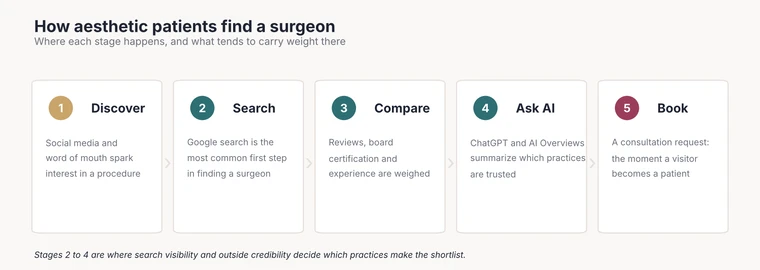
For a practice, that means a strong social media presence and steady content marketing do real work early in a patient's journey, especially on Instagram and Facebook, and paid social can extend that reach. But once a patient starts comparing surgeons, they search, and the practices that tend to show up are the ones with outside credibility, good reviews, and a website Google can read. Because the research above also flags misleading advertising and unrealistic beauty standards, we keep content honest and surgeon-approved: nothing clinical goes live without sign-off.
Surgical Practices
Reconstructive Surgeon: Search Traffic Up 778% in Five Months
The situation: A reconstructive surgeon whose team was already doing everything right. They published quality content every month and stayed active on social media, but the website had hit a ceiling at about 800 visits a month.
What we did: Added the missing piece: expert content on high-authority publications that referenced the practice, concentrated on the practice as a whole so every existing page benefited.
The results: Monthly search traffic grew from 797 to 7,000, and the number of searches the practice ranked for grew from 1,000 to 6,300. A dip in month four rebounded the following month and held.
The lesson: Great content needs outside proof. The stronger your foundation, the faster you grow.
Cosmetic Surgeon: A Neglected Website Grows 12x
The situation: A cosmetic surgeon with a polished, relatively new website that had never been marketed. It drew just 43 visits a month, and several pages were competing with each other for the same searches.
What we did: Built credibility for the practice on a modest budget over about four months, concentrating it on the homepage so Google had one clear page to rank instead of several weaker ones.
The results: Monthly search traffic grew from 43 to 518, and it kept climbing for three months after the program paused.
The lesson: A beautiful website isn't a marketing plan. Design keeps patients once they arrive. Credibility is what brings them.
Rhinoplasty Surgeon: A Damaging Headline Pushed Off Page One
The situation: When patients searched this rhinoplasty surgeon's name, a negative news article about a past legal matter appeared at position 4.
What we did: Strengthened the positive results the surgeon already had (professional profiles, press features, his personal hub page, and his own website) until they crowded the article out.
The results: The article fell from position 4 to roughly position 23, more than two pages deep. The surgeon's team confirmed the problem was resolved.
The lesson: Your first page of Google is your first consultation. You can't always delete a bad result, but you can outnumber it.
Med Spas
UK Med Spa With an Online Store: Search Traffic Up 15x
The situation: An established med spa that also sold products through its website. It had been online for eight years with modest visibility and almost no outside credibility.
What we did: Worked in two phases with a fifteen-month break between them, first building credibility for the brand, then for the store's product categories. During the break, the owner expanded the site from 79 pages to more than 800.
The results: Monthly search traffic grew from 713 to 11,600, and top 3 Google rankings grew from 16 to 195. The owner then brought us in for a second website.
The lesson: Content and credibility multiply each other. And for med spas that sell skincare or aftercare, a store that ranks well becomes its own revenue stream.
Established Med Spa: Halting a Year-Long Decline
The situation: A med spa with years of history that had been losing search visibility for over a year after two major Google updates.
What we did: Rebuilt trust in the brand through expert content on established publications over about five months.
The results: This one is mixed, and we publish it anyway. Top 3 rankings rose from 50 to 60 and the slide finally stopped, but a Google update mid-program meant traffic ended about 23% below where it started. After the med spa paused, the recovery faded.
The lesson: Visibility is maintained, not bought once. Recovery in aesthetics takes longer than growth.
Aesthetic Suppliers and Vendors
Surgical Equipment Store: From Invisible to Cited by AI
The situation: An online store selling equipment plastic surgeons use, live since 2021 but with zero search traffic. Most of its product pages weren't even in Google because of how the site was structured.
What we did: Flagged the structural problem on day one, then built genuine credibility while the owner fixed it.
The results: Traffic went from zero to steady growth, top 3 rankings went from 0 to 9, and the store began appearing in ChatGPT and Google's AI answers.
The lesson: If Google can't see your procedure pages, nothing else you do will reach patients searching for them.
What These Case Studies Have in Common
Across surgical practices, med spas, and suppliers, the same patterns show up again and again.
Outside credibility is the deciding factor. Every one of these businesses had a website. Several had good content. What changed their results was being referenced by credible, independent publications. That's what Google and AI tools treat as proof.
The practice comes first, then the procedures. In nearly every case, we built trust in the practice as a whole before promoting individual procedure or treatment pages. A trusted practice lifts every page on its site.
There's always a quiet period. Most of these practices saw little visible movement for the first one to five months. The ones that stayed the course saw the payoff.
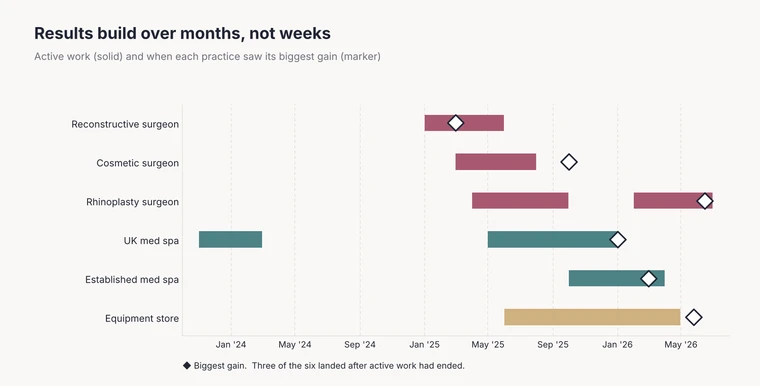
Stopping has a cost. Gains often continue for a while after work pauses, but they fade without maintenance. Your competitors aren't stopping.
AI search follows the same signals. When patients ask ChatGPT who the best injector or surgeon is near them, those tools lean on the same thing Google does: which practices reputable sources reference and trust.
Technical SEO and Site Navigation for a Plastic Surgery Practice Website
Two of the case studies above came down to structure. The cosmetic surgeon's site had several pages competing for the same searches, and the equipment store's product pages weren't in Google at all. More content or more press doesn't fix either problem. That is the job of technical SEO: making sure a practice website is fast, easy for Google to crawl, and clear about what the practice offers.
Site navigation is a big part of it. Google uses links to find new pages to crawl, and its guidance says every page you care about should have a link from at least one other page on your site. For a practice, that means your menu, procedure pages, and location pages should connect in a way that makes sense to patients, and each of your plastic surgery procedures should have one thorough page rather than several thin pages competing with each other.
A new website needs the same care. Design keeps patients once they arrive, but Google has to find and trust the pages first. If you're planning a redesign or launching a new site, our website design work is built around that: fast, mobile-first pages with before-and-after galleries Google can read.
What Prospective Patients Check: The Local Pack, Reviews and Board Certification
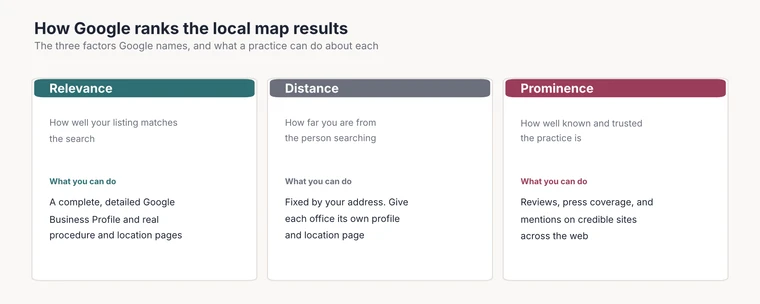
Many patients search for a surgeon by procedure and location, and the first results they see are often the local pack, the map listings at the top of the page. Google says local results are based primarily on relevance, distance, and prominence, and that complete, detailed information in your Google Business Profile helps it match your practice to relevant searches. It also says that high-quality, positive reviews can improve your visibility.
Prospective patients also check who is behind the listing. In the 2024 survey above, board certification was the second most important factor in choosing a plastic surgeon, right behind experience with the procedure. In a 2022 survey in Plastic and Reconstructive Surgery of about 1,000 women imagining they were choosing a breast reconstruction surgeon, online reviews ranked first. So board-certified plastic surgeons should state the credential plainly on their website, and every practice needs a steady way to ask for reviews at the right time and reply without risking patient privacy.
Our local SEO work covers the Business Profile, citations, real location pages, and local links, and we report the calls, direction requests, and website clicks that come from your profile.
How to Judge Any Agency's Case Studies
Before you hire anyone to market your practice, read their case studies with a skeptical eye. Here's what to look for.
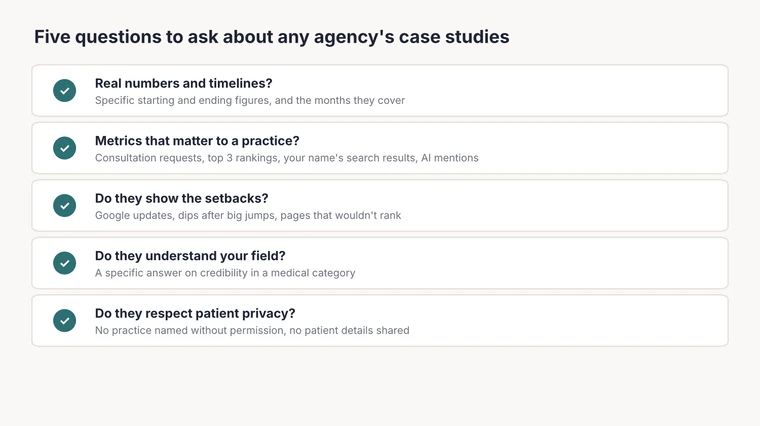
Do they show real numbers and timelines?
"Huge growth" and "dramatically improved rankings" mean nothing. Look for specific starting and ending figures and the months they cover. If an agency can't tell you when results happened, you can't tell whether their work caused them.
Do they measure what matters to a practice?
Traffic is useful, but you can't pay your staff in website visits. The metrics that matter most to a practice are:
- Consultation requests and calls
- Top 3 rankings for procedure and location searches, where patients actually click
- What appears when patients search your name, including reviews and any negative results
- How often AI tools mention or recommend your practice
Do they show the setbacks?
Every real campaign hits bumps: a Google update, a dip after a big jump, a page that won't rank. An agency that only shows wins is either new or hiding something. You'll notice our case studies include the months that went badly.
Do they understand your field?
An agency that markets dentists, roofers, and law firms the same way it markets plastic surgeons doesn't understand the stricter standard Google holds your practice to. Ask how they handle credibility in a medical category, and listen for a specific answer.
Do they respect patient privacy?
Reputable case studies in this field don't name practices without permission and never share patient information. If an agency is careless with another practice's details, assume they'll be careless with yours.
Plastic Surgeon Marketing Strategy: Tracking Consultation Requests and New Patients
The key takeaways above put consultation requests ahead of vanity metrics. Here is what that looks like in practice.
A workable plastic surgeon marketing strategy starts by deciding what counts as a result. For most practices, that is consultation requests: phone calls, form submissions, and booking requests, counted each month and tied to where the patient came from. Traffic and rankings tell you whether the marketing is moving. A consultation request is the first moment a visitor becomes one of your prospective patients.
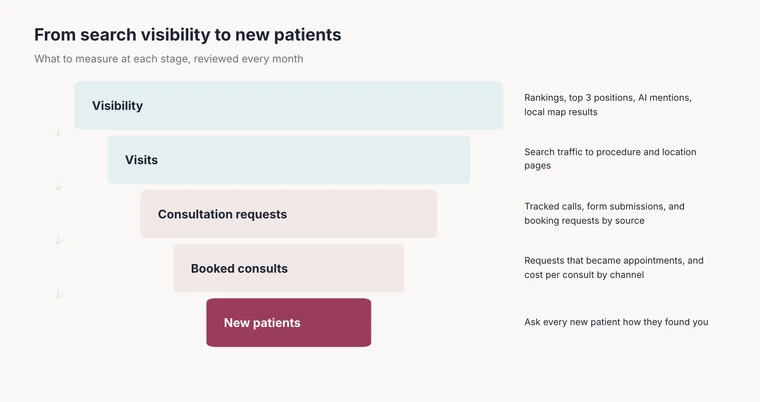
Three things make that measurable. Call tracking shows which calls came from SEO, ads, or your Google profile. Form tracking ties each consultation request back to where the visitor came from. And a monthly report brings rankings, traffic, calls, forms, and booked consults into one place. Our analytics and call tracking setup covers all three, with tracking kept off pages and forms that handle health information.
Once the numbers exist, review them every month. Which procedures are booking consultations, and which need more work? What does each booked consult cost, by channel? Those two questions show you where the next dollar should go.
The channels also work together. SEO takes months to build, so some practices pair it with Google Ads on the searches most likely to book, within the advertising rules for medical services. Together, they make up a patient acquisition plan you can measure instead of guess at. If you'd like a second opinion on yours, request a marketing audit.
See Your Own Results as They Happen
Every Sculpted Search client gets our client dashboard, which brings together your rankings, website traffic, technical site health, and how often AI tools like ChatGPT mention your practice. When a quiet month or a Google update happens, you see the full picture instead of wondering.
It also includes a built-in reputation management tracker, something no other marketing agency in our field offers, so you always know what prospective patients see when they search your name.
Frequently Asked Questions
How long does it take to see results?
Most practices in these case studies saw little visible change for the first one to five months, followed by steady or rapid growth. Practices with a strong existing foundation, like active content and social media, tend to respond fastest.
Why aren't the practices named?
Many surgeons and med spa owners prefer to keep their marketing private, and in some cases, such as reputation work, naming the practice would defeat the purpose. Every number in these case studies comes from real client data.
Does this work for med spas as well as surgical practices?
Yes. Med spas face the same high-stakes standard from Google, and often more local competition. Two of the case studies above are med spas, including one that also sells products online.
Can you help with a negative review or news article?
Yes. Our rhinoplasty case study shows how we pushed a damaging news result from position 4 to roughly position 23. Every client's dashboard also tracks what appears when patients search their name.
What about AI search?
AI tools like ChatGPT and Google's AI Overviews increasingly influence which practices patients consider. They favor practices that credible sources reference, which is exactly what our approach builds. Your dashboard shows how often AI tools mention your practice.
Will my results look like these?
Every practice starts from a different place, so no honest agency can promise specific numbers. What these case studies show is what's possible, and how long it typically takes.
What should I look for in plastic surgeon marketing case studies?
Look for real starting and ending numbers with the months they cover, metrics that matter to a practice such as consultation requests and top 3 rankings, honest setbacks, a real understanding of medical marketing, and respect for patient privacy. The checklist above walks through each one. If you'd like us to apply the same standards to your own site, request a marketing audit.
What is the best marketing strategy for a plastic surgery practice?
No single tactic does it. The case studies above point to a sequence: make sure Google can see your pages, build outside credibility steadily, keep your Google Business Profile and reviews healthy, and track consultation requests so you know what's working. Where to start depends on where your practice stands today, which is what an audit is for. You can read more about how we approach SEO and AI search.
How do I track consultation requests and new patients from my website?
Use call tracking and form tracking so each phone call and consultation request is tied to the source that produced it, then review the totals every month alongside rankings and traffic. It also helps to ask every new patient how they found you, since not everyone calls a tracked number or fills out a tracked form. Keep tracking tags off pages and forms that handle health information.
Does social media help a plastic surgery practice get new patients?
It helps with awareness. In a 2015 study, 40% of the patients who used social media were strongly influenced by it when choosing a specific doctor. But in a 2024 survey of U.S. adults considering plastic surgery, a surgeon's experience, board certification, and years in practice mattered most, and the number of social media posts ranked among the least important factors. Treat social media as one part of your presence, alongside search, reviews, and outside credibility.
Should a plastic surgeon use Google Ads as well as SEO?
Often the two work together. SEO takes months to build, while Google Ads can reach people searching for a procedure right away. Ads for medical services have to follow advertising rules, so campaigns should be tight and compliant. The right mix depends on your budget and how much outside credibility your practice already has.
How do I show up in the Google local pack?
Google says local results are based primarily on relevance, distance, and prominence. Complete, detailed information in your Google Business Profile helps with relevance, and high-quality, positive reviews can improve your visibility. You can't change how far you are from the person searching, but you can keep your business details consistent across the web, give each office its own real location page, and earn local press.
About the author
This roundup was written by the Sculpted Search team. Sculpted Search is a digital marketing agency built for aesthetic plastic surgeons, reconstructive surgeons, med spas, and medical suppliers, covering SEO, content, press, ads, websites, and AI search visibility. The agency is led by CEO Artemis Peacocke, who reviews every audit herself, and its team includes an SEO lead, a content lead, an outreach lead, and an outreach specialist. The team works white-hat only, gets surgeon sign-off on anything clinical, and reports in plain English each month. Ask for a marketing audit to see where your practice stands.