
Case Study: A Cosmetic Surgeon's Overlooked Website Grows 12x in Search Traffic
How a few months of steady, expert content turned a neglected practice website into a growing source of patient traffic
By the Sculpted Search team | Published: [Date, 2026]
Why Search Visibility Matters for Cosmetic Surgery Practices
Patients research before they book. In a 2015 peer-reviewed study of 500 consecutive patients at an aesthetic medicine and cosmetic surgery clinic, 95% used the internet to collect information before their consultation, and for 68% of them a search engine was their first search method. A more recent U.S. survey in Plastic and Reconstructive Surgery (2024) found that a web search was the most common first step for potential patients looking for plastic surgeons, at 32.2%. In the same study, respondents rated the surgeon's experience with the procedure, board certification, and years in practice as the most important factors in choosing one.
That last finding matters for your website. A surgeon's credibility has to show up online, in the places patients and Google already look. Google also holds health topics to a higher bar. It says its systems give even more weight to strong E-E-A-T on topics that could significantly affect people's health, and a surgeon's website sits squarely in that territory. That helps explain why a site with no credible mentions had such a hard time. Sculpted Search builds SEO, content, press and AI search programs for exactly this kind of practice.
Understanding the Patient Mindset, Education, and Social Media
To succeed in marketing plastic surgery and marketing plastic and reconstructive services, we must understand the modern patient education journey. How does social media influence plastic surgery? Many prospective patients turn to social media and media marketing for inspiration before booking a monthly consultation. When reviewing cosmetic surgery articles and the occasional cosmetic surgery journal article, distinct patterns emerge. Academic literature, such as "a review of psychosocial outcomes for patients seeking cosmetic surgery" and "effects of social media use on desire for cosmetic surgery among young women", highlights a deep correlation between online exposure and patient intent.
Furthermore, broader studies like "social media influence on body image and cosmetic surgery considerations: a systematic review" and inquiries examining "do perceptions about body image influence the acceptance of cosmetic surgery" reveal the complex psychological reasons for plastic surgery. This intent is why basic surgery marketing, marketing social tactics, or standard marketing social media posts aren't enough. You need authoritative search visibility combined with strategic social media marketing to build lasting trust with existing patients and new prospects alike.
A Beautiful Website Nobody Was Finding
This cosmetic surgeon had done what many surgeons do: invested in a polished, professional website design, launched it, and moved on to running the practice.
The site looked great. But almost no one was finding it. It drew about 43 visits a month from Google. It had been mentioned by only 17 other websites, nearly all low-quality directories and automated scraper sites. Not one credible publication had ever referenced it.
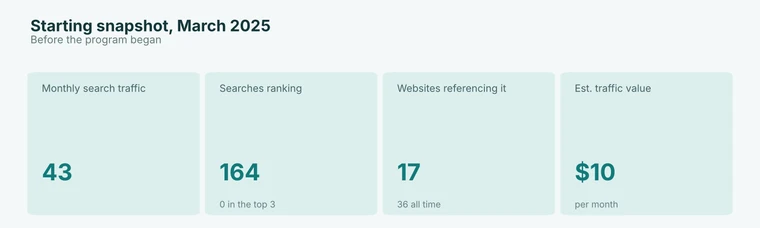
To Google, the site was a stranger. Well built, but with no evidence that anyone trusted it.
The Approach: Earn Trust One Month at a Time
Because the site had essentially no credibility to build on, we treated it as a fresh start.
Start with the practice, not the procedures. We focused first on the homepage, building trust in the surgeon and the practice as a whole before promoting individual procedure pages.
Climb steadily. In the first months of the campaign, we placed expert content on solid, mid-tier publications. By June, we'd moved up to highly authoritative ones. Rising gradually looks natural to Google. A sudden flood of attention to a little-known site looks suspicious, especially in a medical category.
Lead with the name. The content referenced the practice by name, not with keyword-stuffed phrasing on a keywords page or chasing highly-searched ranking keywords. That's how real businesses get talked about, and it's what Google expects to see.
The Hidden Problem: Pages Competing With Each Other
While reviewing the site, we found an issue that's extremely common on surgeon websites. Several pages were competing for nearly the same searches.
When multiple pages on one site chase the same search, Google can't tell which one to rank. It splits the credit between them, and often none of them rank well. Rankings can swing wildly from week to week.
Rather than overhaul the site mid-program, we concentrated the practice's new credibility on its homepage, letting it become the clear authority for the practice's most important searches, while internal links guided visitors to the deeper pages.
It worked. Google chose the homepage as the practice's main page for its most valuable searches, and it became the biggest single source of new visitors.
The Results
The surgeon paused the program in July 2025 for budget reasons. The results didn't stop.
| Mar 2025 | Oct 2025 | |
|---|---|---|
| Monthly search traffic | 43 | 518 |
| Credible websites referencing the practice | 17 | 53 |
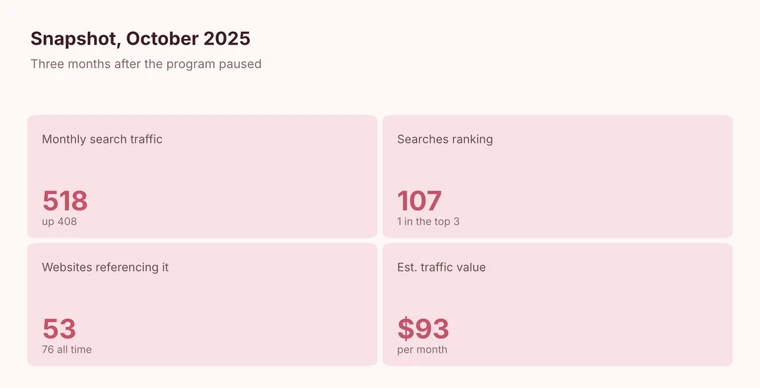
By October, three months after the last piece of content went out, monthly organic traffic had grown from 43 to 518, an increase of about 1,100%. The site also came through several Google algorithm updates during that time without losing ground.
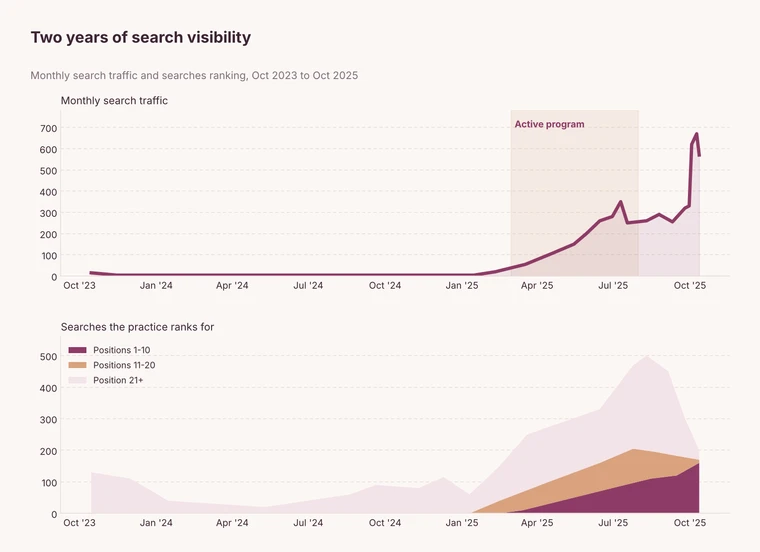
Even pages we never directly promoted started getting more visitors. As Google's trust in the practice grew, it lifted the whole site.
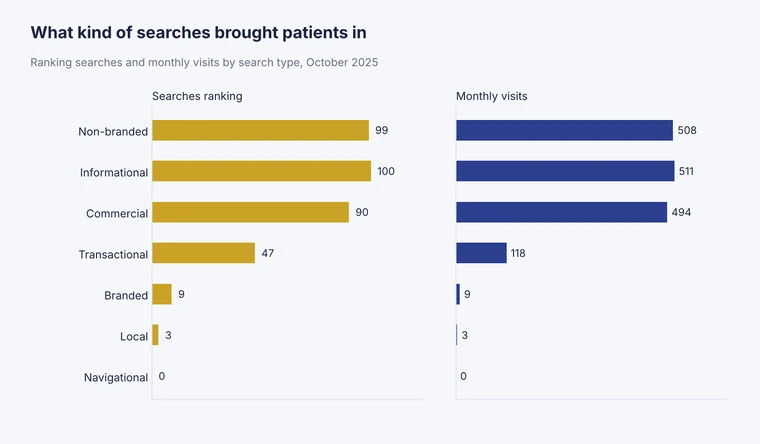
The Numbers Behind This Cosmetic Surgery SEO Case Study
Numbers are only useful when you know where they came from. Here are the figures behind this case study, in one place:
- Starting point: About 43 visits a month from Google.
- Mentions at the start: 17 websites, nearly all low-quality directories and scraper sites, and no credible publications.
- Program dates: March to July 2025.
- When results were measured: October 2025, three months after the last piece of content went out.
- Result: 518 visits a month, an increase of about 1,100%, or roughly 12x.
We checked the headline numbers against each other, and they hold up. Going from 43 to 518 is a gain of 475 visits. Divide 475 by 43, and you get about 11.05, which is roughly 1,100% growth. Divide 518 by 43, and you get about 12, which is where the 12x comes from.
The site also held its gains through several Google updates. Google's Search Status Dashboard lists three confirmed ranking updates between March and October 2025: the March 2025 core update, the June 2025 core update, and the August 2025 spam update.
One caveat. This is one practice on one modest budget. Results vary, and nobody can honestly promise a ranking. Google's own guidance says no one can guarantee a #1 position, and we say the same.
What This Means for Your Practice
A great website isn't a marketing plan. Design gets patients to stay once they arrive. Credibility is what gets them to arrive in the first place.
A few months of steady work can change everything. This practice went from nearly invisible to a real source of patient traffic on a modest budget, and the gains kept building after the work stopped.
Too many similar pages can hold you back. If you have several pages for overlapping procedures or services, Google may not know which to show. Consolidating your strength often beats spreading it thin.
Momentum needs maintenance. Growth continued for months after this program paused, but it naturally slows without new credibility being added. Competitors keep working, and Google keeps updating.
AI search rewards the same credibility. When patients ask ChatGPT or Google's AI tools to recommend a cosmetic surgeon, those tools favor practices that reputable sources reference and trust.
How to Apply These Lessons to Your Own Practice
If we were advising a cosmetic surgeon who was starting from a quiet website tomorrow, we would work through these five steps in order.
- Check for competing pages. In Google Search Console, check whether more than one page is showing for the same important search.
- Pick one page to carry your credibility. In this case study, that was the homepage. Link from it to your deeper procedure pages so visitors can find them.
- Earn real mentions, and let them build gradually. Expert content on respected publications, with your practice named plainly, looks more natural to Google than a sudden flood of attention.
- Track more than traffic. Watch your rankings, your visits, how AI tools describe your practice, and what patients see when they search your name. Ensuring your Google Business Profile (or business profile / Google Business) appears in the local pack for local search and local seo is vital. Our reviews and reputation service covers the review side of that picture.
- Keep adding credibility. Growth in this case continued after the program paused, but momentum slows when no new credibility is added. Plan for steady work, not a one-time push.
Want a second opinion on your own website? Request a marketing audit for a short report on where you rank, how AI answers describe your practice, what your competitors are doing, and the quickest wins.
See Your Growth as it Happens
Every Sculpted Search client gets our client dashboard, which shows your rankings, website traffic, and how often AI tools like ChatGPT mention your practice, all in one place. Technical health reports also flag issues like competing pages before they cost you patients.
It also includes a built-in reputation management tracker, something no other marketing agency in our field offers, so you always know what patients see when they search your name.
If your practice website looks great but isn't bringing in patients, it may only be missing one thing: a reason for Google to trust it.
Frequently Asked Questions (FAQ)
What did this cosmetic surgery SEO case study find?
A well-designed but unmarketed surgeon website grew from 43 to 518 monthly visits from Google, an increase of about 1,100%, or roughly 12x. The program ran from March to July 2025 and focused on building credibility for the homepage. Traffic kept climbing for months after the program paused, and the homepage became the biggest single source of new visitors. This is one practice's result, so treat it as a pattern to learn from, not a promise.
How long does SEO take to work for a cosmetic surgeon?
It depends on what you want to rank. In our experience, map rankings usually move in three to four months, and procedure pages take six to twelve. In this case study, the 518-visit figure was measured in October 2025, roughly seven months after the program began in March. No one can promise a ranking, and Google agrees.
What is keyword cannibalization, and why does it matter for surgeons?
Keyword cannibalization is when several pages on one site target the same search and the same intent, so they compete with each other. On surgeon websites, overlapping procedure and service pages are a common cause. The result can be split credit between pages and rankings that swing from week to week, which is what we saw on this site.
Why focus on the homepage instead of the procedure pages?
The site had almost no credibility to build on, so we started by building trust in the surgeon and the practice as a whole. We concentrated that credibility on the homepage instead of overhauling the site mid-program, and used internal links to guide visitors to the deeper pages. Google then chose the homepage as the practice's main page for its most valuable searches. Procedure pages still matter. They simply come after trust in the practice is in place. See how we build procedure pages.
Do SEO results last after you pause the work?
Some of the gains can. The surgeon in this case paused the program in July 2025, and monthly traffic had still grown to 518 by October. But momentum needs maintenance. Competitors keep working and Google keeps updating, so growth naturally slows when no new credibility is added. Think of SEO as steady work, not a one-time project.
Can SEO help a cosmetic surgeon show up in ChatGPT and Google's AI answers?
It can help, but no one can guarantee a mention. Google says its generative AI features are rooted in its core Search ranking and quality systems, so SEO fundamentals still apply, and it warns that chasing inauthentic mentions is less helpful than it might seem. That fits the approach in this seo case study: real expert content on credible publications, with the practice named plainly. We can't control what ChatGPT or other tools say, so we track how often they name a practice instead of promising a result. You can read more about our AI search visibility service.
How do I know an SEO provider is working safely on a medical website?
Ask them to explain exactly what they plan to do, and ask to see every placement. Google's guidance on hiring an SEO warns against companies that are secretive or won't explain their methods, and it reminds site owners that they are responsible for what a hired company does. At Sculpted Search, we work white-hat only, with no private blog networks, paid link farms, or spammy guest posts, because they can work for a while and then take a medical site down with them. Every mention we earn is listed in the client's monthly report.
About the author
This case study was written by the Sculpted Search team. Sculpted Search is a digital marketing agency built for aesthetic plastic surgeons, reconstructive surgeons, med spas, and medical suppliers, covering SEO, content, press, ads, websites, and AI search visibility. The agency is led by CEO Artemis Peacocke, who reviews every audit herself, and its team includes an SEO lead, a content lead, an outreach lead, and an outreach specialist. The team works white-hat only, gets surgeon sign-off on anything clinical, and reports in plain English each month. Ask for a marketing audit to see where your practice stands.