
Case Study: Bringing an Established Aesthetic Practice Back Into View
How expert content and third-party features halted a year-long decline in patient search visibility
A Strong Reputation That Google Had Stopped Rewarding: An Aesthetic Surgery SEO Recovery Case Study
This practice wasn't new. It had years of treatment content on its website and a reputation it had earned. But since late 2024, fewer and fewer prospective patients were finding it through Google.
Two of Google's major algorithm updates, in August 2024 and June 2025, lined up with the drops. By October 2025, monthly visits from search were well below their peak, and the practice was showing up for far fewer searches than it used to.
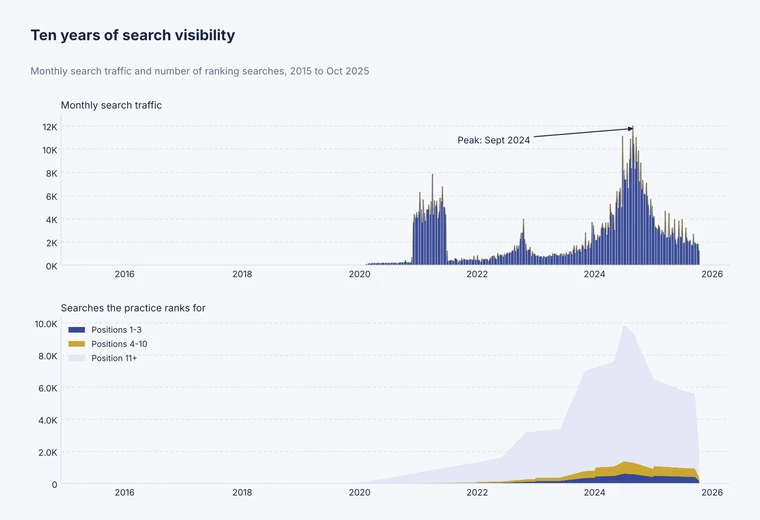
For a practice that relies on new patients finding it online, that shows up in one place: fewer consultation requests.
Why Cosmetic Surgery SEO Holds Practices to a Higher Standard
Google treats anything involving health, procedures, or the body as a high-stakes category. It wants to see real evidence that a practice is credible before it puts that practice in front of patients. When Google updates its algorithm, practices in this category tend to feel it more than most businesses.
The same is now true of AI search. When a patient asks ChatGPT, Google's AI Overviews, or Perplexity for the best place to get a treatment nearby, those tools lean on the same signals: is this practice mentioned and trusted by other reputable sources?
What the Data Told Us: An Initial SEO Audit of The Website
Before creating anything, we analyzed the practice's online footprint. Three findings shaped the plan.
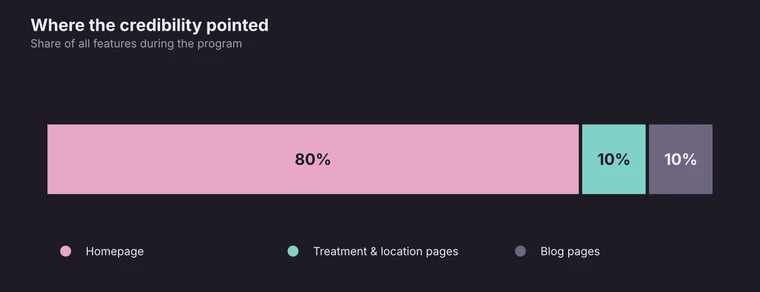
Its credibility was scattered. The practice had been mentioned on some strong outside websites, but most of those mentions pointed to individual blog posts rather than to the practice itself. The brand wasn't getting credit for its own reputation.
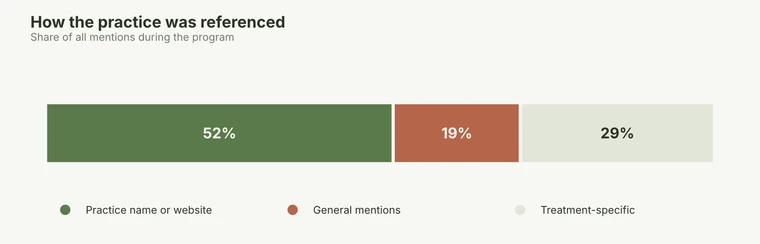
Some of its promotion looked too aggressive. A growing share of its outside mentions used keyword-heavy phrasing instead of the practice's name. In a medical category, that can read as manipulative to Google.
There had never been a consistent effort. The practice had invested once, in 2023, and then stopped. The decline began in the gap that followed.
Rebuilding Plastic Surgery SEO After an Organic Search Decline
This plastic surgery SEO case study shows how a focused SEO audit, credible link building, and content optimization helped an established aesthetic practice recover organic traffic and strengthen local SEO visibility. Rather than relying on additional advertising, the strategy rebuilt trust around the practice’s brand before improving individual procedure pages and local visibility.
The SEO Link Building Approach: Credibility First, Then Momentum
Phase 1: Put the practice's name at the center (October 2025)
We started by creating expert articles for established outside publications, each one referencing the practice by name and sending readers to its main website. The goal was to rebuild trust in the brand as a whole before promoting any individual treatment.
Phase 2: Raise the caliber (November to December 2025)
As the site responded, we moved into more authoritative publications and began giving select treatment and location pages their own features, while keeping the practice's main site as the priority.
Phase 3: Accelerate (January to February 2026)
With the foundation in place, nearly every feature ran on high-authority publications. We held this back until the site was ready, because a sudden surge of attention can look unnatural to Google in a medical category.
Throughout, the content led with the practice's name rather than keyword-stuffed promotion, correcting the problem we found at the start.
How Strategic Link Building Improved Local Visibility and Consultation Calls
Through consistent SEO link building and content optimization, the plastic surgery practice strengthened its search engine presence and improved local visibility for high-intent treatment searches. The campaign focused on building credibility for the practice first, then supporting key procedure pages, helping more prospective patients find the site through organic search rather than relying only on Google Ads or social media.
The Results: Restoring Organic Traffic and Local SEO Visibility
| Oct 2025 | Mar 2026 | |
|---|---|---|
| Searches ranking in Google's top 3 | 50 | 60 |
| Site authority score* | 35 | 39 |
*Domain Rating, a widely used measure of how much trust a website has built.
The top 3 positions matter most. That's where a patient searching for a treatment in their area actually clicks.
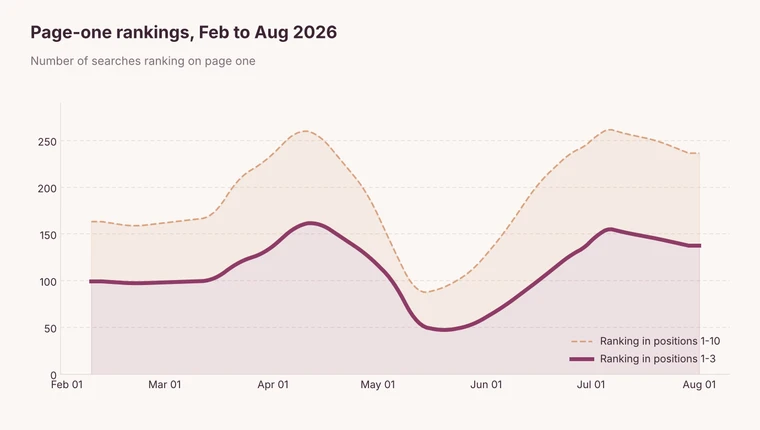
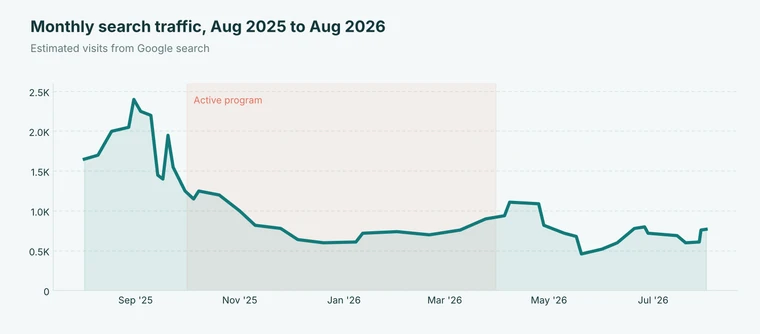
Traffic, honestly: a major Google update hit in December 2025, in the middle of the campaign, and pushed monthly search visits down from about 774 to a low of 444 in January. By March, they had climbed back to about 594. That's still about 23% below where we started, but it was the first time in over a year the trend pointed up.
After the pause: the practice paused the program in spring 2026, and visits have since settled back to a low, flat baseline.
What This SEO Case Study Means for Your Plastic Surgery Practice
Visibility is maintained, not bought once. This practice's decline began after a one-time investment ended, and its recovery faded after the work stopped again.
In aesthetics, credibility is built over months. Google and AI tools both reward practices that are consistently referenced by trusted sources. Five months was enough to stop the decline and turn the corner, but not enough to lock in the gains.
Watch the numbers tied to patients. Top 3 rankings and a trusted brand are what put you in front of people ready to book. Total traffic can swing with Google's updates in the short term.
If your practice has a strong reputation but the phone isn't ringing like it used to, an established name is a far better starting point than a blank slate, as long as the work is given time to build.
Frequently Asked Questions (FAQ)
How long does an aesthetic surgery SEO recovery take with a professional SEO company?
Based on this surgery SEO case study, we started seeing the first sustained traffic recovery and top-3 ranking improvements in about five months (from October to March). However, because medical and cosmetic surgery websites are held to a higher standard, locking in those gains requires consistent, ongoing effort rather than a one-time push.
Why did our organic traffic drop even though our website is established?
Google treats health and medical procedures as a high-stakes category. If a plastic surgery practice stops building its digital credibility, or if previous link building relied heavily on aggressive, keyword-stuffed phrasing instead of natural brand mentions, major algorithm updates can cause the site to lose its visibility.
Should we focus on our homepage or procedure pages first?
When recovering from an organic search decline, it is often best to focus on the practice's name and homepage first. Rebuilding trust in your brand as a whole gives Google a reason to trust your site again before you begin directing authority to individual procedure pages or chasing local SEO terms.
Do we need to keep investing in digital marketing after traffic recovers?
Yes. As the data in this seo case study shows, momentum requires maintenance. When the practice paused their program in the spring, their visits settled back to a low, flat baseline. Competitors keep working, and search engines keep updating, meaning your strategy must be continuous to protect your rankings.
About the author
This case study was written by the Sculpted Search team. Sculpted Search is a digital marketing agency built for aesthetic plastic surgeons, reconstructive surgeons, med spas, and medical suppliers, covering SEO, content, press, ads, websites, and AI search visibility. The agency is led by CEO Artemis Peacocke, who reviews every audit herself, and its team includes an SEO lead, a content lead, an outreach lead, and an outreach specialist. The team works white-hat only, gets surgeon sign-off on anything clinical, and reports in plain English each month. Ask for a marketing audit to see where your practice stands.