
Case Study: Moving a Damaging Headline Off a Rhinoplasty Surgeon's First Page
How we buried a negative news result from position 4 to position 23 for a surgeon's own name
Plastic Surgery Marketing: Protecting Patient Trust and Patient Acquisition
Your first page is your first consultation
Rhinoplasty patients research harder than almost anyone. Before they book, most of them type the surgeon's name into Google and read what comes up. Whatever sits on that first page is, in effect, the surgeon's first impression.
For this surgeon, one of the first things a prospective patient saw was a news article about a past legal matter, sitting at position 4. It didn't matter how strong his results, reviews, or credentials were. That headline was doing the talking before he ever met the patient.
His team came to us with one goal: push that article down, ideally off the first page entirely.
The stakes are rising with AI search, too. When a patient asks ChatGPT or Google's AI Overviews about a surgeon, those tools summarize what they find on the open web. A negative article that dominates search results can easily become part of the answer.
Digital Marketing for Cosmetic Surgeons: A Local SEO Strategy Built for Search Results
The strategy: don't fight the article, outnumber it
You usually can't make a news article disappear. What you can do is give Google better options to show instead.
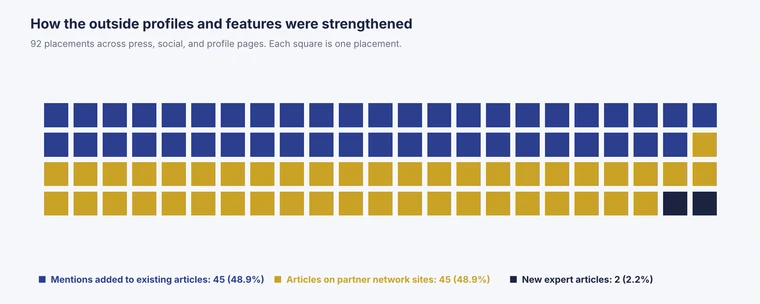
The surgeon already had a solid base to work from: his professional profiles, a personal hub page that linked all of his presences together, press features about his practice, social profiles, and his own website. Each one spoke well of him. None of them were strong enough yet to outrank a news site.
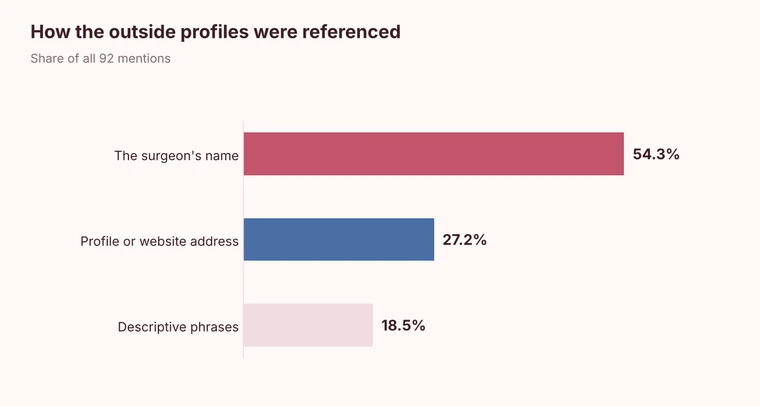
So rather than betting on one new page, we strengthened the whole set. We published a steady stream of expert content across established sites that referenced and pointed to these positive results, raising their credibility in Google's eyes. The more trusted pages that compete for his name, the less room there is on page one for the article.
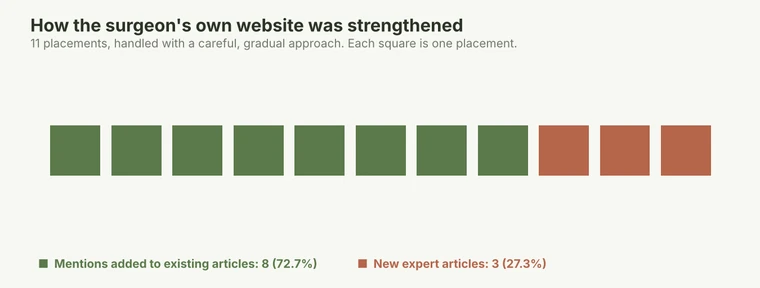
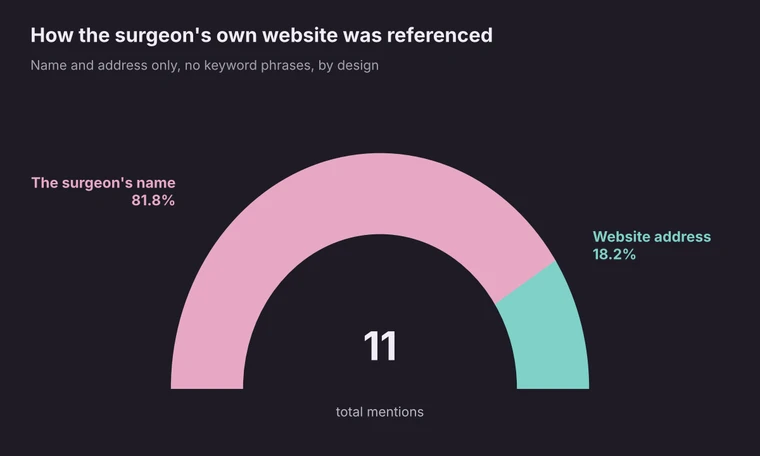
We also matched our approach to each property. Profiles and features hosted on large, established platforms could handle a faster push. His own website got a more careful, gradual approach, because a practice's own site is the one asset you never want to put at risk.
How Local SEO Supports a Surgeon’s Reputation
A strong reputation strategy does not stop at pushing down one negative result. For any plastic surgery practice, local SEO helps ensure that the surgeon’s name, practice name, and location are represented accurately across search results.
Optimizing the practice’s Google Business Profile, maintaining consistent name-address-phone information, and earning reviews from real patients all reinforce trust. These signals also help prospective patients find verified information about the surgeon’s credentials, services, and consultation process.
For a facial plastic surgery practice, local search visibility matters because patients often search for both the surgeon’s name and nearby treatment options. A well-maintained local presence gives Google more credible results to display alongside press coverage, professional profiles, and the practice website.
Executing SEO Plastic Surgery Strategies Beyond Paid Ads and Landing Pages
How it unfolded
Act 1: Building the foundation (April to September 2025) The first stretch focused on the results already showing promise: his hub profile, professional profiles, press features, and social presence. They climbed steadily. His hub profile reached the very top of the first page, and his professional profiles held page one throughout.
The article, meanwhile, didn't move. It held position 4 for six straight months.
This is the hardest part of reputation work for any client to sit through. Credibility takes time to register with Google. The work done in one month often doesn't show up for several more.
Using Social Media and Content Marketing to Build Trust
Social media gives prospective patients a more human view of a plastic surgeon’s practice. Educational posts, patient-education content, behind-the-scenes updates, and professional commentary can support the credibility of the surgeon’s website, press features, and profile pages.
Content marketing works in a similar way. High-quality SEO content that answers real patient questions can help a surgery practice rank for informational searches while demonstrating expertise. This is especially useful in cosmetic surgery, where patients often research procedures, recovery expectations, and surgeon qualifications before booking a consultation.
The goal is not to create content for search engines alone. It is to give patients useful, accurate information while strengthening the set of positive results that appear when someone searches the surgeon’s name.
Intermission: A planned pause (winter 2025) The surgeon's team paused the program over the winter while they brought on new procedures and team members.
Act 2: Widening the wall (February to June 2026) When we resumed, we added two new results to the effort: a positive regional news feature about the surgeon and his own practice website. The aim was to put even more favorable pages in competition for his first page.
Why Website Design and Technical SEO Matter
A surgeon’s website is often the most important owned asset in a reputation strategy. Clear website design, fast loading pages, mobile-friendly layouts, and well-organized service pages make it easier for both patients and search engines to understand the practice.
Technical SEO also plays a role. An updated XML sitemap, clean internal linking, proper metadata, and dedicated location pages help search engines crawl and index the site correctly. For a plastic surgery center, this makes it easier for high-quality pages about rhinoplasty, facial plastic surgery, and other surgery services to compete in search results.
Unlike paid ads, which disappear when the budget stops, a well-optimized website can continue supporting organic referral visits and consultation requests over time.
The Results
| Start | End | |
|---|---|---|
| Negative article | Position 4 | Position ~23 |
| Personal hub profile | Page one | Top of page one |
| Professional profiles | Page one | Held page one throughout |
Then the break came. By the time the program wound down in mid-2026, the article had dropped from position 4 to around position 13, off the first page. By late June, it had fallen further, to roughly position 23. A patient looking up the surgeon would now have to dig through more than two pages of results to find it.
What didn't go to plan: The regional news feature never ranked during our window. A single story on a large news site can be stubborn, which is why we spread the effort across many results instead of depending on one. The surgeon's own website climbed as high as #2, then slipped to page two near the end. That wasn't a decline. His first page simply filled up with so many strong, positive results that they crowded each other. In reputation work, that's exactly what success looks like.
The program ended in June 2026 for the best possible reason: the goal was met, and the surgeon's team confirmed the problem was resolved.
Marketing Case Study Takeaways: Securing High-Quality Search Results for a Facial Plastic Surgery Practice
Why it worked
No single page had to win. By strengthening a whole portfolio of positive results, we made the first page too crowded for the article to keep its spot.
Patience paid off. The article sat unmoved for months, then dropped after the heaviest work was done and kept dropping after we stopped. Reputation gains build on themselves.
Reputation is never finished. New results appear and old ones fade, so search results for a surgeon's name are always shifting. Keeping positive results reinforced is what keeps a buried headline from creeping back.
Measuring Patient Acquisition Beyond Rankings
Rankings matter, but they are only part of the picture. A complete digital marketing strategy should also track website traffic, branded search volume, consultation requests, phone calls, and organic conversions.
For plastic surgeons, the most important question is whether improved search visibility leads to more qualified patient inquiries. A negative article moving from position 4 to page two is meaningful, but so is seeing more patients arrive through organic search, local search, and referral visits.
Tracking these results together helps a marketing agency understand which channels support real business goals. It also shows whether reputation work, local SEO, content, and paid media are contributing to long-term patient acquisition rather than short-term clicks.
Watching your reputation in real time
That last point is why every Sculpted Search client now gets our client dashboard, which includes a built-in reputation management tracker, something no other marketing agency in our field offers.
Instead of finding out about a problem when a patient mentions it in a consultation, you can see what appears when people search your name, track how negative results are moving, and watch your positive results take their place. It sits right alongside your rankings, website traffic, and AI search visibility, all in one place.
If there's a result on your first page you'd rather patients didn't see, it doesn't have to stay there.
Frequently Asked Questions (FAQ)
What is the main takeaway from this marketing case study?
This marketing case study shows that the best way to handle a negative news article is not to try and delete it, but to outnumber it. By leveraging search engine optimization to build credibility for a surgeon's positive profiles and assets, you can push damaging headlines off the first page, protecting patient trust and driving organic referral visits.
How does reputation management impact patient acquisition for cosmetic surgeons?
For cosmetic surgeons and surgery practices, your first page of Google is effectively your first consultation. If prospective patients search your name and find a negative headline at position 4, they may never make it to your website. Cleaning up search results directly protects your consultation requests and overall patient acquisition, whether you run a single facial plastic clinic or a large plastic surgery center.
Why shouldn't a surgery practice rely solely on Google Ads and paid media for reputation?
While Google Ads, paid media, and Facebook Instagram campaigns can drive immediate clicks, they do not push down negative organic results. A robust strategy built on content marketing, local SEO, and optimizing your Google Business profile will increase organic referral traffic and increase conversions long-term without the constant cost of paid ads.
Do I need a marketing agency to handle technical SEO for my plastic surgery center?
Yes. Effective plastic surgeon marketing requires more than just a beautiful website design. A specialized marketing agency handles the technical SEO, optimizing your XML sitemap, location pages, and services page to ensure search engines crawl your site correctly. Unlike a general marketing firm, an agency focused strictly on aesthetics understands how to use high-quality SEO content to deliver real numbers and increase organic growth year over year.
About the author
This case study was written by the Sculpted Search team. Sculpted Search is a digital marketing agency built for aesthetic plastic surgeons, reconstructive surgeons, med spas, and medical suppliers, covering SEO, content, press, ads, websites, and AI search visibility. The agency is led by CEO Artemis Peacocke, who reviews every audit herself, and its team includes an SEO lead, a content lead, an outreach lead, and an outreach specialist. The team works white-hat only, gets surgeon sign-off on anything clinical, and reports in plain English each month. Ask for a marketing audit to see where your practice stands.