
Case Study: Search Traffic Up 778% in Five Months for a Reconstructive Surgeon
What happens when a practice already doing the right things adds outside credibility to the mix
Why Search Visibility Matters for a Reconstructive Surgeon's Online Presence
Patients research before they book. In a 2015 study in Aesthetic Plastic Surgery, 95% of 500 consecutive patients at an aesthetic plastic surgery clinic used the internet to collect information before their consultation, and for 68% of them the internet was their first search method. That study looked at aesthetic patients rather than reconstructive ones, so it shows how people use the internet around plastic surgery in general, not how every reconstructive patient searches. Still, reconstructive surgery is a major part of plastic surgery, and many reconstructive surgeons are also board-certified plastic surgeons, so the habit is worth taking seriously.
Search engines also hold medical websites to a higher standard. Google says its systems give even more weight to content with strong E-E-A-T (experience, expertise, authoritativeness and trustworthiness) on topics that could significantly affect people's health. A reconstructive surgeon's website sits squarely in that territory. In a competitive market, a practice can publish excellent content and still struggle to rank for high-value searches when few credible sources outside the website vouch for it. That is exactly where this practice started.
This is why healthcare marketing for a reconstructive practice has to reach beyond the practice's own channels. The website and social media build the foundation. Credibility from independent sources is what helps that foundation compete in the searches that drive patient acquisition.
Understanding the Patient Mindset: Social Media, Reviews and Search Results
Patients rarely rely on a single source. In the same 2015 study, 46% of patients used social media, and 40% of those users were strongly influenced by it when choosing a specific doctor.
Reconstructive patients often face a heavier decision. A 2022 survey in Plastic and Reconstructive Surgery asked about 1,000 women to imagine they had breast cancer and were choosing a surgeon for reconstruction. Online reviews on physician-rating sites ranked as the most important factor, followed by recommendations from another surgeon and years of experience. Online advertising ranked among the least important. The researchers noted that these decisions are often guided by referral processes at major medical centers, but that choosing a surgeon remains a subjective process. Because the women were imagining a scenario rather than making a real choice, treat the findings as a clue, not a rulebook.
Both studies point the same way. Patients give a lot of weight to what independent sources say about a surgeon, and in our experience, so does Google. That is why SEO, content marketing and social media work best as a team. The practice in this case already had high-quality content and an active social presence. What it added was outside proof.
A Practice That Was Already Doing the Work
Most practices that come to us have neglected their online presence. This one hadn't.
The surgeon's team was publishing quality content on the website every month. They were active on social media and showing up everywhere a healthy, established practice should. By most measures, they were doing everything right.
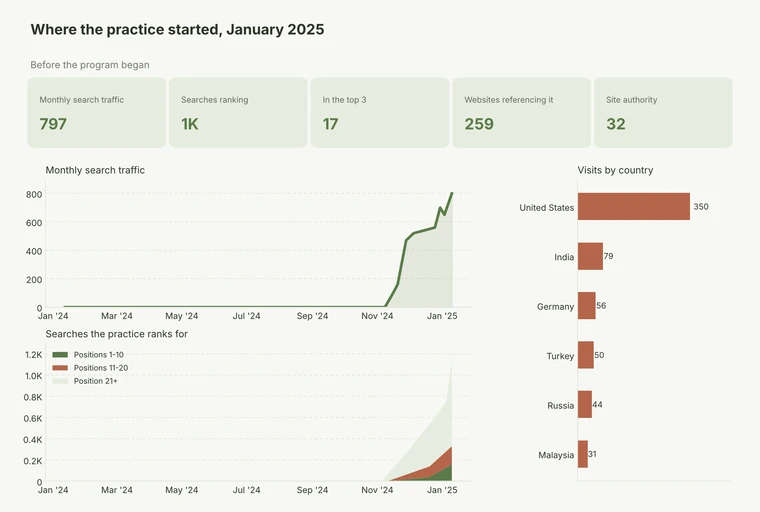
But they were capped. Their website drew about 797 visits a month from Google and ranked for around 1,000 searches. Good content alone wasn't enough to beat competitors for the searches that bring in new patients. What was missing was outside proof: credible, independent sources vouching for the practice.
Practices like this are our favorite kind of client because they respond fastest. When the foundation is solid, credibility has something real to amplify.
The Approach: Amplify What Was Already Working
Since the site already had a strong base, we didn't need to start slowly. We went straight to high-authority publications.
Concentrate on the practice itself. About 90 to 95% of our effort pointed to the practice's homepage. The goal was to raise trust in the practice as a whole, so all of its existing content would benefit, rather than promoting pages one at a time.
Spread a little further. The remaining effort supported five or six key pages on the site, so the practice's most important topics also got a direct lift.
Keep it natural. The content referenced the practice in the way real publications talk about real businesses, mostly by name and in natural language, with only a measured amount of procedure-specific phrasing.
Review every month. We checked results monthly and adjusted where the practice's credibility was directed based on how the site responded.
The Results, Month by Month
| Month | Searches ranking | Monthly search traffic |
|---|---|---|
| Jan 2025 | 1,000 | 797 |
| Feb 2025 | 2,100 | 2,600 |
| Mar 2025 | 4,600 | 7,700 |
| Apr 2025 | 5,000 | 5,300 |
| May 2025 | 6,300 | 7,000 |
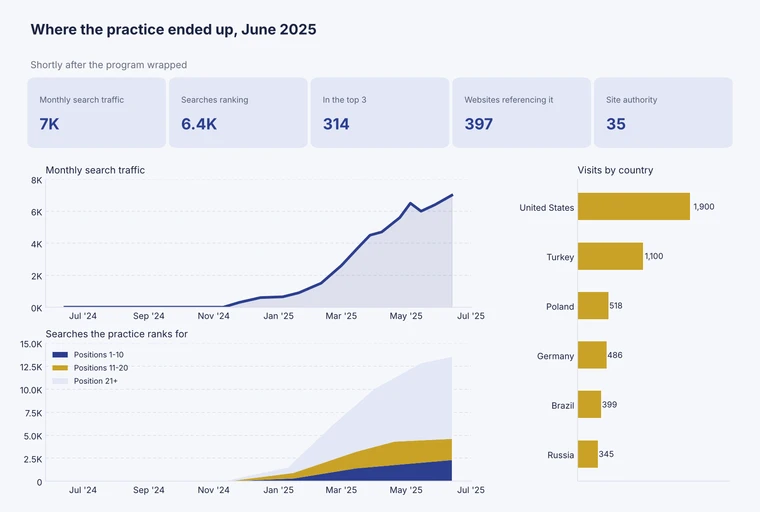
Within two months, traffic had more than tripled. By March, it was nearly ten times where it started.
By May, the practice ranked for more than six times as many searches as it had in January, and its monthly traffic was up 778%.
About That April Dip
In April, after two record months, traffic fell from 7,700 to 5,300. This is the moment where many practice owners panic and pull the plug.
We didn't, and neither did the surgeon. Google regularly re-evaluates websites after a big jump, testing whether the growth is real. Search growth rarely moves in a straight line. It looks more like an investment chart than a staircase.
The next month, traffic rebounded to 7,000 and held. The credibility behind it was genuine, so the gains stuck.
The Numbers Behind This Reconstructive Surgeon SEO Case Study
Numbers are only useful when you know where they came from. Here are the figures behind this case study, in one place:
- Starting point: About 797 visits a month from Google and roughly 1,000 searches ranked for in January 2025.
- Program dates: January to May 2025.
- End point: 7,000 visits a month and 6,300 searches ranked for in May 2025.
- Result: Organic traffic up 778% and searches ranked for up 530%.
We checked the headline numbers against each other, and they hold up. Going from 797 to 7,000 visits is a gain of 6,203. Divide 6,203 by 797 and you get about 7.78, which is roughly 778% growth. For rankings, going from 1,000 to 6,300 searches is a gain of 5,300, and 5,300 divided by 1,000 is 5.3, or 530%.
The month-by-month table tells the same story. February's 2,600 visits were about 3.3 times January's 797, and March's 7,700 were nearly ten times January's. April's 5,300 was about 31% below March, and May's 7,000 recovered to about 91% of the March peak, which is still nearly nine times where the practice started.
The program also ran through a confirmed Google core update. Google's Search Status Dashboard shows the March 2025 core update rolling out from March 13 to March 27, 2025. We can't say how much any single update shaped any single month, but traffic was still up 778% by May.
One caveat. This is one practice over five months. Results vary, and nobody can honestly promise a ranking. Google's own guidance says no one can guarantee a #1 position, and we say the same.
What This Means for Your Practice
Great content needs outside proof. This practice was publishing good material every month and still couldn't break through. Credible, independent sources are what convinced Google its content deserved to rank.
The stronger your foundation, the faster you grow. Practices that are active online, on social media, and in their community respond fastest, because there's more for credibility to amplify.
Dips are normal. Quitting is the real risk. A single down month after a big jump is Google checking its work. Practices that stay the course keep the gains.
AI search looks for the same signals. When patients ask ChatGPT or Google's AI tools about a surgeon or a procedure, those tools favor practices that reputable sources reference. The credibility that lifts Google rankings is the same credibility AI relies on.
How to Apply These Lessons to Your Own SEO Strategy
If we were advising a reconstructive surgeon who wanted to increase organic traffic and already had good content and an active social presence, we would work through these five steps in order. Case studies like this one show a pattern, not a promise, so adjust them to your own practice.
- Start with an SEO audit. Find out which pages rank, which ones Google isn't showing, and how your content, social media and local listings are working together. Tie what you learn to your business goals, such as more consultations for breast reconstruction or more referrals for hand surgery.
- Make sure the foundation is solid. Credibility amplifies what is already there. That means a site search engines can crawl (technical SEO), a mobile-friendly website design, and a complete Google Business Profile for local search. The practice in this case already had a strong base, which is a big reason it responded so quickly.
- Pick one page to carry your credibility. In this case, about 90 to 95% of the effort pointed to the homepage, and the rest supported five or six key pages. Concentrating credibility lets all of the practice's existing content benefit.
- Earn real mentions that read naturally. Expert content on high-authority publications, naming the practice the way real publications talk about real businesses, did the work here. Procedure-specific phrasing was kept to a measured amount.
- Review monthly and stay the course. Watch your rankings, your organic traffic, how AI tools describe your practice, and what patients see when they search your name. Adjust where your credibility is directed, and don't pull the plug after a single down month.
Want a second opinion on your own website? Request a marketing audit for a short report on where you rank, how AI answers describe your practice, what your competitors are doing, and the quickest wins.
Know What's Happening, Especially in the Down Months
Every Sculpted Search client gets our client dashboard, which shows your rankings, website traffic, and how often AI tools like ChatGPT mention your practice, all in one place. When a month like April happens, you see the full picture instead of wondering whether something's wrong.
It also includes a built-in reputation management tracker, something no other marketing agency in our field offers, so you always know what patients see when they search your name.
If your practice is already doing the work but your website has hit a ceiling, the missing piece may not be more content. It may be proof that others trust it.
Frequently Asked Questions (FAQ)
What did this reconstructive surgeon SEO case study find?
A reconstructive surgeon's practice that already had good content and an active social presence grew monthly search traffic from 797 to 7,000 (up 778%) between January and May 2025, and the number of searches it ranked for rose from 1,000 to 6,300 (up 530%). We built credibility through expert content featured on high-authority publications, with about 90 to 95% of the effort pointed at the practice's homepage. This is one practice's result, so treat it as a pattern to learn from, not a promise.
What is a reconstructive surgeon?
A reconstructive surgeon repairs or rebuilds parts of the body affected by injury, infection, tumors, disease, or conditions a person is born with or that develop over time. The aim is usually to restore function, and sometimes also to restore a more typical appearance, according to the American Society of Plastic Surgeons. Reconstructive surgery is a major part of plastic surgery, and many reconstructive surgeons are board-certified plastic surgeons. If you are a surgeon, you can read more about our approach to SEO for reconstructive surgeons.
What are some examples of reconstructive surgeries?
Common examples include breast reconstruction after a mastectomy or lumpectomy, cleft lip and cleft palate repair, skin cancer removal and reconstruction of the area afterward, burn care and post-burn reconstruction, hand surgery, ear surgery, scar revision, and complex wound care. Which ones a practice offers varies by surgeon, so a website should name the specific procedures the surgeon performs.
Why wasn't good content enough for this practice?
The surgeon's team was publishing quality content every month and was active on social media, yet the website drew about 797 visits a month and ranked for around 1,000 searches. Good content alone wasn't enough to beat competitors for the searches that bring in new patients. What was missing was outside proof: credible, independent sources vouching for the practice. That matters even more for health topics, because Google says its systems give extra weight to strong E-E-A-T on topics that could significantly affect people's health.
Why did traffic drop in April, and should a practice worry about a dip?
Traffic fell from 7,700 in March to 5,300 in April, then rebounded to 7,000 in May. In our experience, Google tends to re-check whether growth is real after a big jump, and search growth rarely moves in a straight line, so a single down month is not a verdict. The practice stayed the course, and because the credibility behind the growth was genuine, the gains stuck. Our client dashboard shows the full picture in months like April, so you are not left guessing whether something is wrong.
How long does SEO take to work for a reconstructive surgeon?
It depends on the site and the searches. This practice moved quickly: traffic had more than tripled by February and was nearly ten times January's level by March, helped by a strong foundation for credibility to amplify. Most practices should expect a longer timeline. In our experience, map rankings usually move in three to four months, and procedure pages take six to twelve. No one can promise a ranking, and results vary from practice to practice.
Can SEO help a reconstructive surgeon show up in ChatGPT and Google's AI answers?
It can help, but no one can guarantee a mention. In our experience, AI tools favor practices that reputable sources reference, so the credibility that lifts Google rankings is the same credibility AI relies on. We can't control what ChatGPT or other tools say, so we track how often they name a practice instead of promising a result. You can read more about our SEO and AI search work.
How do I know an SEO provider is working safely on a medical website?
Ask them to explain exactly what they plan to do, and ask to see every placement. Be wary of anyone who guarantees a ranking, because Google's guidance on hiring an SEO says no one can guarantee a #1 position. Health topics get extra scrutiny, so shortcuts like private blog networks, paid link farms or spammy guest posts can work for a while and then take a medical site down with them. At Sculpted Search, we work white-hat only, we get surgeon sign-off on anything clinical, and every mention we earn is listed in the client's monthly report.
About the author
This case study was written by the Sculpted Search team. Sculpted Search is a digital marketing agency built for aesthetic plastic surgeons, reconstructive surgeons, med spas, and medical suppliers, covering SEO, content, press, ads, websites, and AI search visibility. The agency is led by CEO Artemis Peacocke, who reviews every audit herself, and its team includes an SEO lead, a content lead, an outreach lead, and an outreach specialist. The team works white-hat only, gets surgeon sign-off on anything clinical, and reports in plain English each month. Ask for a marketing audit to see where your practice stands.